

When your air conditioner breaks down, the hardest question isn’t how to fix it — it’s whether you should fix it at all or put that money toward a new system. One simple guideline has become popular for making that call quickly: the $5,000 rule. The cooling team at Mainstream Electric, Heating, Cooling, & Plumbing uses it as a starting point with homeowners across Spokane and Spokane Valley, and here’s exactly how it works — plus where it falls short.
What Is the $5,000 Rule?
The $5,000 rule is a quick formula for deciding between repair and replacement. You take the cost of the proposed repair and multiply it by the age of the air conditioner in years. If the result is more than $5,000, replacement is usually the smarter investment. If it’s under $5,000, a repair is generally worth it.
It’s popular because it bakes in the one factor homeowners tend to ignore: age. A $400 repair on a 4-year-old unit ($1,600) is an easy yes. That same $400 repair on a 14-year-old unit ($5,600) tips toward replacement, because you’d be sinking money into a system near the end of its life.
How to Use the Rule: A Few Examples
- $300 repair on an 8-year-old AC: 300 × 8 = $2,400 → repair.
- $600 repair on a 10-year-old AC: 600 × 10 = $6,000 → lean toward replacement.
- $250 repair on a 12-year-old AC: 250 × 12 = $3,000 → repair is reasonable.
- $700 repair on a 15-year-old AC: 700 × 15 = $10,500 → replace.
As you can see, the rule naturally pushes older units toward replacement even for moderate repair bills — which usually reflects reality.
Where the $5,000 Rule Falls Short
The rule is a helpful gut check, not the whole story. It ignores a few things that can swing the decision:
- Energy efficiency. A 15-year-old unit might run at a fraction of the efficiency of a modern system. Even a ‘worth it’ repair keeps you paying inflated power bills all summer.
- Refrigerant type. Older systems often use R-22 (commonly called Freon), which has been phased out and is now expensive or unavailable — a refrigerant leak alone can justify replacement.
- Repair frequency. If this is the third repair in two summers, the math on a single repair understates the real cost of keeping the system.
- Comfort and reliability. An aging system that struggles on the hottest days may never keep you comfortable, no matter how many parts you replace.
The Refrigerant Factor in Older Units
This one deserves its own mention. The U.S. has phased out R-22 refrigerant, so systems that rely on it face skyrocketing costs whenever they need a recharge — if the refrigerant can be sourced at all. If your AC is more than about 12–15 years old and develops a refrigerant leak, the repair can cost so much that replacement with a modern, efficient system is the clear winner. We’ll always tell you which refrigerant your system uses and what that means for the decision.
When a Repair Still Makes Sense
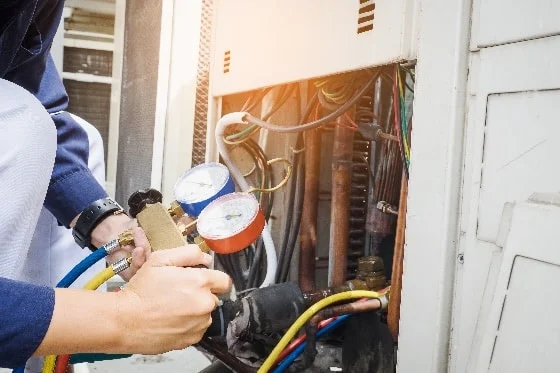
Plenty of repairs are absolutely worth it — a failed capacitor, a bad contactor, a clogged drain line, or a worn fan motor on an otherwise healthy, efficient system are routine fixes. If your AC is under about 10 years old, has been maintained, and the repair is straightforward, fixing it is usually the right move. Our AC repair technicians give you the honest repair cost up front so you can run the numbers yourself.
Still on the Fence About an Older Unit?
If your system is creeping toward the two-decade mark, it’s worth reading our companion guide on whether it’s worth fixing a 20-year-old AC unit. Age changes everything about this decision.
Other Repair-or-Replace Rules You’ll Hear
The $5,000 rule isn’t the only shorthand out there. Another common one is the 50% rule: if a repair costs more than half the price of a comparable new system, replace it. A third is the half-life rule: once a unit passes the midpoint of its expected lifespan and needs a major repair, lean toward replacement. None of these is gospel — they’re all just different ways of weighing repair cost against remaining useful life. When they agree, the decision is easy. When they disagree, that’s exactly when a technician’s eyes on the actual system are worth more than any formula.
Maintenance History Changes the Math
A unit that’s had annual maintenance its whole life often has more good years left than the calendar suggests, while a neglected one may be worn out early. Before you apply any rule, factor in how the system has been cared for — and remember that the cheapest way to avoid this decision altogether is to keep up with regular tune-ups so small problems never become major repairs.
Get an Honest Repair-or-Replace Assessment
The $5,000 rule gets you in the ballpark, but a real recommendation considers your system’s efficiency, refrigerant, and repair history together. Let our team take a look and lay out your options — no pressure. Explore AC repair and AC replacement, or contact Mainstream. We help homeowners across Spokane, Spokane Valley, and Coeur d’Alene make the call with confidence.